30-Second Readiness Check for Coaches: A Simple Daily System That Prevents Bad Training Decisions
Published Updated
These are educational coaching guides, not medical advice. Monitoring does not predict or prevent an individual injury. Treat numerical examples as illustrations, not validated safety thresholds. Seek qualified healthcare advice for persistent pain, illness or unexplained fatigue.
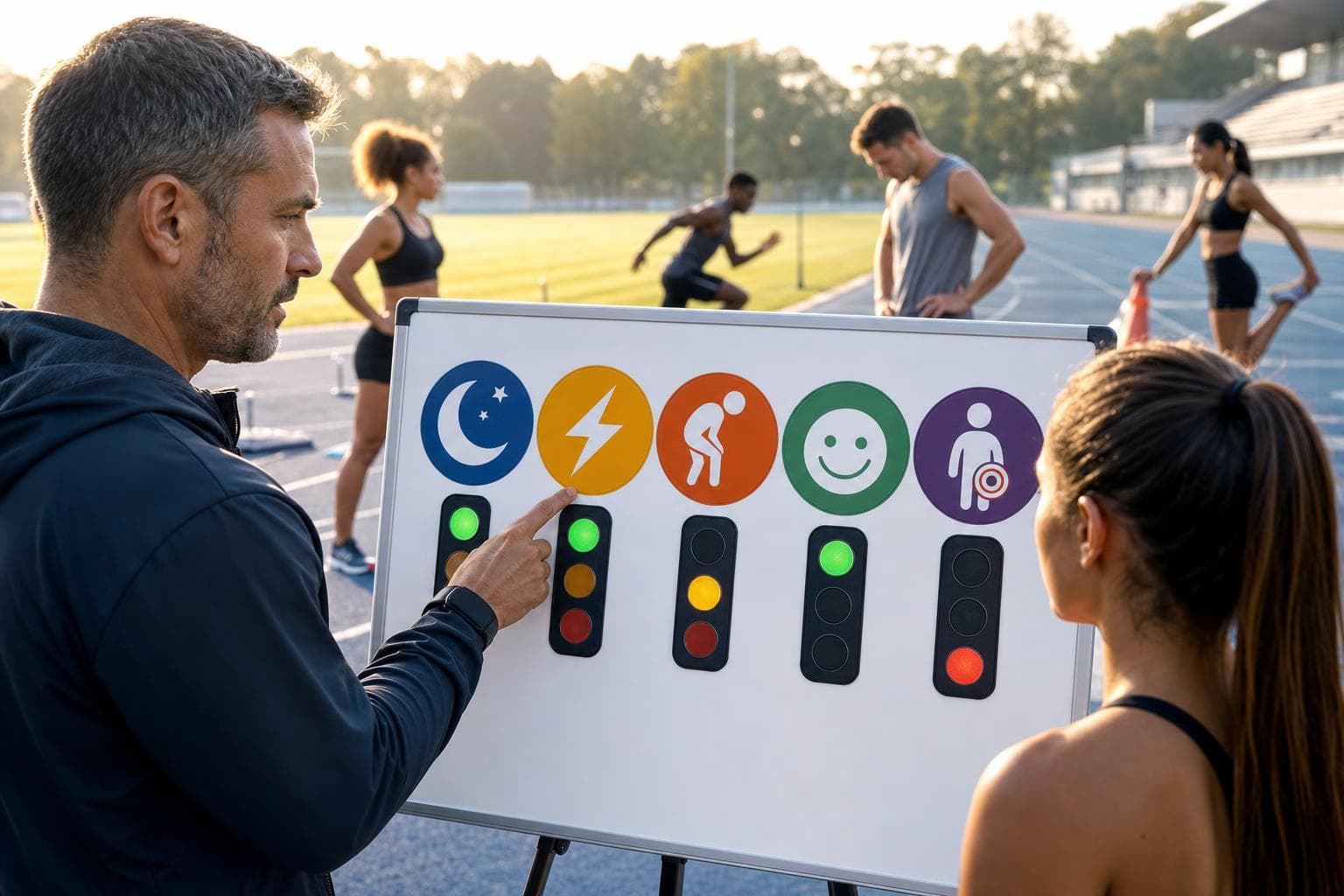
Most poor training decisions are not caused by bad intent. They are caused by late information.
A coach sees the warning signs only after performance drops, motivation crashes, or pain escalates.
A 30-second readiness check solves that. It gives you one fast daily snapshot before load decisions are locked in.
Why coaches need a readiness check (even with a strong plan)
A written plan is necessary. But daily reality changes faster than weekly programming:
- sleep quality can collapse after travel or exams
- life stress can spike overnight
- soreness can accumulate from hidden load
- pain signals can appear before obvious injury
If you only react to session results, you are often one or two days late. A short readiness check helps you intervene while adjustment is still cheap.
The 5-signal framework (30 seconds total)
Ask every athlete to rate these five signals each morning (or pre-session):
- Sleep quality
- Energy level
- Soreness
- Mood / motivation
- Pain / niggle status
Use a simple 1–5 scale (or green/yellow/red). Consistency matters more than complexity.
Practical rating rule
- 5 (green): clearly better than normal
- 3 (yellow): normal baseline
- 1 (red): clearly worse than normal
Keep definitions stable across the season. Changing the scale every few weeks destroys comparability.
Coach decision rules that actually work
Data only helps when tied to action. Use clear rules athletes understand in advance.
Rule 1: Two or more signals down = adjust that day
If two or more metrics are below baseline, reduce session stress:
- cut volume by ~20–40%
- keep quality but reduce density
- extend recovery between hard sets
Rule 2: New or sharp pain = stop and reassess
Pain is not just another fatigue marker. It changes risk immediately.
- switch to low-risk alternatives
- avoid “testing through” sharp pain
- follow your medical/referral protocol
Rule 3: Three-day trend beats one-day noise
One bad day is normal. Three consecutive low-readiness days usually means accumulated stress is winning.
At that point, modify the microcycle—not just one session.
How readiness and load should be used together
Readiness alone can be misleading. Load alone can be misleading.
Together, they become coach-grade decision support.
- Load up + readiness stable: adaptation may be on track
- Load stable + readiness down: non-training stress may be driving fatigue
- Load up + readiness down: high overload risk, adjust now
- Load down + readiness still down: recovery strategy is not working yet
This is where simple daily monitoring outperforms guesswork.
Common implementation mistakes
1) Asking vague questions
"How do you feel?" produces vague answers. Structured prompts produce usable signals.
2) Collecting data but not changing sessions
If athletes report low readiness and the plan never changes, trust collapses.
3) Treating all athletes as one average
Team-level trends are helpful, but decisions are still individual.
4) Ignoring mood and motivation
Mood shifts often appear before performance decline. They are not “soft” signals—they are early warnings.
5) Overengineering the system
You do not need 20 variables. Five consistent markers beat a complex dashboard nobody completes.
A simple rollout you can start this week
- Define your 5 readiness questions in one sentence each.
- Set one fixed scale (1–5 or green/yellow/red).
- Collect responses daily for 14 days.
- Add three coach actions linked to low-readiness patterns.
- Review trends twice per week with your staff.
Within two weeks, you will usually spot patterns you previously missed.
What changes when this is done well
Coaching quality improves in three ways:
- Earlier intervention: fewer preventable overload blocks
- Cleaner communication: athletes report specific signals, not vague feelings
- Better planning confidence: session adjustments are grounded, not reactive
The goal is not to eliminate hard training. The goal is to place hard training on days athletes are ready to benefit from it.
That is how performance compounds.
How Athlog supports this workflow
Athlog helps coaches operationalize readiness checks without extra admin burden:
- fast daily athlete check-ins
- readiness trends over time
- load context in the same workflow
- clear coach-athlete communication history
A 30-second check sounds small. In practice, it can be the difference between planned progression and avoidable setbacks.
Evidence and limitations
- Hausswirth et al. (2014). Evidence of disturbed sleep and increased illness in overreached endurance athletes.
This endurance-athlete study links functional overreaching with disturbed sleep and illness. A poor night or questionnaire score alone cannot diagnose overtraining.
- Foster et al. (2001). A new approach to monitoring exercise training.
Original cycling and basketball experiments support session-RPE as a practical measure of training demand. They do not validate injury prediction or a universal safe load.