The Best Athlete Monitoring Metrics (and Which Ones to Ignore)
Published Updated
These are educational coaching guides, not medical advice. Monitoring does not predict or prevent an individual injury. Treat numerical examples as illustrations, not validated safety thresholds. Seek qualified healthcare advice for persistent pain, illness or unexplained fatigue.
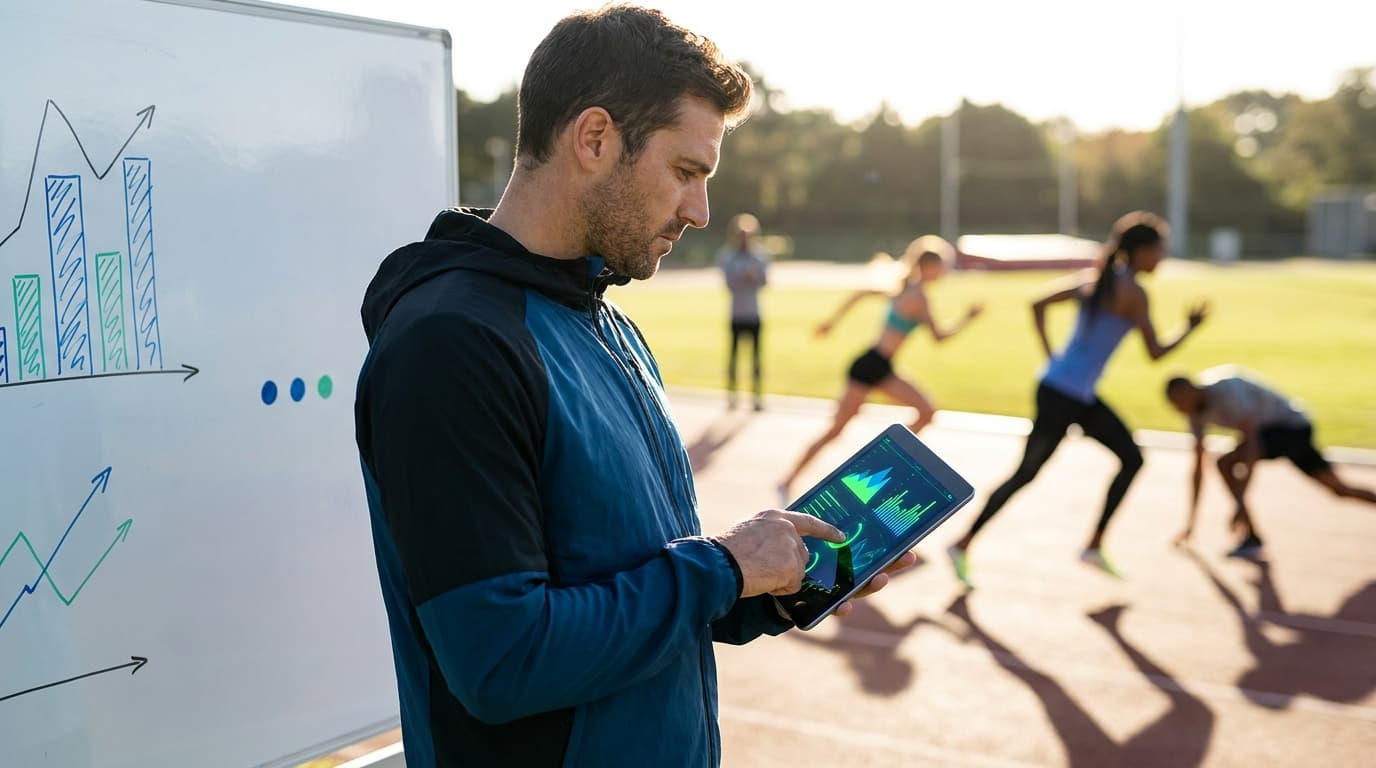
Most coaching environments do not have a data problem. They have a decision problem.
Teams collect heart-rate files, GPS traces, jump tests, wellness scores, sleep data, and match stats — but still miss warning signs, overreact to noise, or lose time discussing numbers that do not change training decisions.
The goal of athlete monitoring is not to track everything. The goal is to make better choices, earlier.
This guide gives you a practical stack of metrics that works in real coaching settings, plus a list of common numbers you can safely de-prioritize.
Start with one rule: only track what changes action
Before adding a metric, ask one question:
“If this number moves, what exactly will we do differently today or this week?”
If the answer is vague, the metric is probably noise.
Great monitoring systems are not the biggest ones. They are the clearest ones: a small set of reliable signals linked to specific coaching actions.
The metrics that usually deliver the highest value
1) Session load (sRPE × duration)
For most teams, this is the foundation.
After each session, athletes report effort (RPE 1–10). Multiply by minutes.
- Easy 45-minute recovery run at RPE 3 → 135 AU
- Hard 75-minute interval session at RPE 8 → 600 AU
Why it matters:
- Works across sports and session types
- Captures internal stress, not only external output
- Requires no expensive hardware
- Gives immediate weekly and monthly load trends
Action examples:
- Weekly load spike above plan? Reduce volume in the next 48–72 hours.
- Repeatedly high loads with falling readiness? Hold intensity, trim volume.
2) Acute vs chronic load trend (7-day vs 28-day context)
Raw load is useful. Load in context is better.
A simple 7-day to 28-day comparison helps you spot whether current stress is aligned with what the athlete is prepared for.
You do not need to treat any threshold as absolute truth. Use it as a decision support flag.
Action examples:
- Sharp short-term jump after travel/illness break? Rebuild progressively over 7–10 days.
- Sustained low load before key competition? Add controlled stimulus to avoid under-preparation.
3) Daily wellness check-in (short and consistent)
A 30-second morning check often catches issues before performance drops.
Keep it tight:
- Sleep quality
- Fatigue/energy
- Muscle soreness
- Mood/motivation
- Stress
Use simple 1–5 scales. Do not overcomplicate forms.
Why it matters:
- Detects readiness shifts load data alone cannot explain
- Improves coach-athlete communication
- Helps interpret poor sessions with context, not guesswork
Action examples:
- Two or more categories down for 3+ days? Switch planned hard session to controlled quality.
- Wellness improves while load stays stable? Progress as planned.
4) Pain tracking (location + severity + trend)
Pain reporting is often the missing piece.
One daily yes/no is not enough. Capture:
- Location
- Severity (1–5 or 0–10)
- Trend (better/same/worse)
- Training impact (none/modified/stopped)
Why it matters:
- Repeated low pain is often a stronger warning than one high score
- Lets coaches intervene before missed training blocks
Action examples:
- Same-location pain reported 3 times in a week? Adjust load and movement exposure immediately.
- Worsening pain + declining wellness + high load? Treat as red flag and modify plan now.
5) Adherence metrics (planned vs completed)
This one is underrated.
Track how much of the plan athletes actually complete — not what was prescribed on paper.
Why it matters:
- Exposes hidden load gaps (too much or too little)
- Reveals execution quality of the program
- Improves forecasting for competition readiness
Action examples:
- Athlete consistently completes 65% of planned intensity? Fix structure, not just motivation.
- Team-wide drop in adherence during exam weeks? Adjust periodization around real life constraints.
6) A small set of sport-specific performance markers
Use 1–3 key performance indicators that are stable and meaningful in your sport.
Examples:
- Running: pace at fixed RPE, interval repeatability
- Team sports: high-speed exposure consistency, repeated effort tolerance
- Strength/power: bar-speed trend at known loads, jump trend over time
The key is consistency of testing conditions.
Action examples:
- Performance marker flat while load rises? Check recovery quality before adding stimulus.
- Marker improving with manageable fatigue? Stay patient and keep progression steady.
Metrics coaches often overvalue (or misuse)
1) Single-day readiness scores without trend context
A one-off low score does not equal crisis. Treat daily values as signals, not verdicts.
2) Device metrics with poor reliability in your environment
If a wearable gives inconsistent data across sessions, it creates false confidence. Reliability beats sophistication.
3) “More dashboards” as a performance strategy
Extra charts rarely improve coaching if decision rules are unclear.
4) Vanity aggregates that never trigger action
If your weekly report includes numbers nobody discusses in planning meetings, remove them.
5) Chasing perfect precision
Monitoring is a direction tool. You need useful trends, not lab-level certainty.
A simple decision model coaches can use weekly
Use this 3-step review:
- Load: Is stress rising, stable, or dropping relative to recent weeks?
- Response: Are wellness and pain signals coping with that stress?
- Outcome: Are performance markers and adherence moving in the right direction?
Then choose one of four actions:
- Progress load
- Hold load
- Redistribute load (same total, different structure)
- Deload/recover
This prevents overreaction and creates repeatable decision quality across staff.
What a high-signal monitoring stack looks like
If you want a practical baseline, start here:
- Session load (sRPE × minutes)
- 7-day vs 28-day load context
- 5-item daily wellness check
- Daily pain trend logging
- Planned vs completed adherence
- 1–3 sport-specific performance markers
That is enough to make better coaching decisions in most environments — from youth development to high-performance teams.
Final takeaway
The best athlete monitoring metrics are not the most advanced ones. They are the ones your staff and athletes can collect consistently, interpret correctly, and act on quickly.
If a metric does not improve decisions, it is admin. If it improves timing and clarity, it is performance.
Platforms like Athlog help coaches combine load, wellness, pain, and adherence in one place so signals are easier to spot and easier to discuss. But the real edge is not the software — it is disciplined decision-making around the right metrics.
Track less. Decide better. Win more training weeks.
Evidence and limitations
- Foster et al. (2001). A new approach to monitoring exercise training.
Original cycling and basketball experiments support session-RPE as a practical measure of training demand. They do not validate injury prediction or a universal safe load.