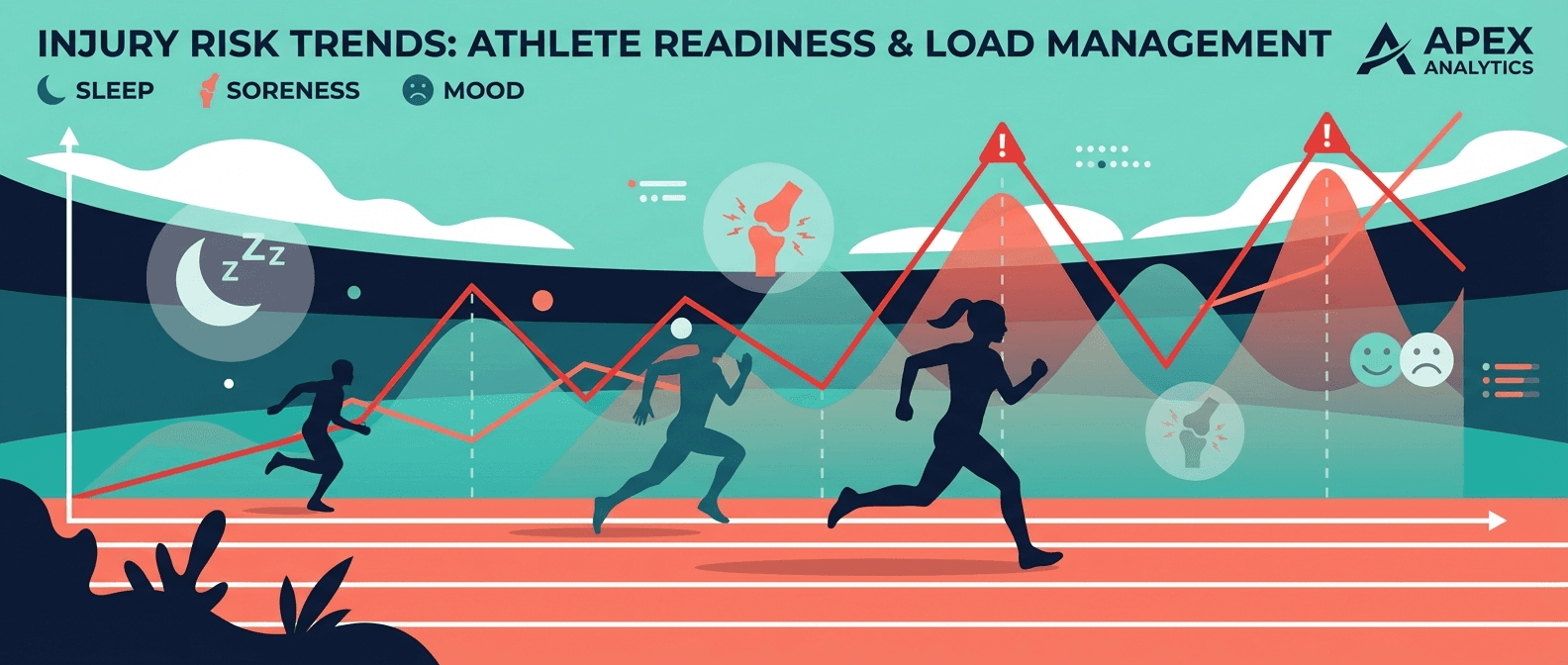
How to Spot Injury Risk Trends Early Using Load, Wellness, and Pain Tracking

Author Athlog Team

Most sports injuries don't appear out of nowhere. They build up over days and weeks — through accumulated fatigue, ignored warning signs, and training loads that creep beyond what the body can absorb. By the time an athlete feels a sharp pain in their hamstring or an ache in their knee that won't go away, the damage has been developing for a while.

The good news: the warning signs are usually there. The challenge is seeing them.

This article lays out a practical framework for coaches who want to catch injury risk trends early, using three data streams that most structured training environments already collect — or could start collecting with minimal effort.


The three signals that matter

Injury risk rarely comes from one factor alone. It's the intersection of training stress, recovery capacity, and tissue tolerance that determines whether an athlete stays healthy or breaks down. Each of these maps to a trackable data stream:

  1. Training load — how much work the athlete is doing (volume, intensity, session RPE × duration).
  2. Wellness — how the athlete is recovering (sleep quality, fatigue, mood, general readiness).
  3. Pain reporting — what the body is telling them (location, severity, pattern over time).

Individually, each stream tells part of the story. Together, they give coaches a surprisingly clear picture of where trouble is heading.

Why all three?

A high training load alone doesn't predict injury. Some athletes handle massive volume without issues because they recover well and have no underlying tissue problems. Conversely, a moderate load can break down an athlete who is sleeping poorly, carrying lingering soreness, and ignoring a nagging Achilles tendon.

The risk lies in the combination: rising load + declining wellness + emerging or worsening pain = danger zone.


Tracking training load: what to capture and what to watch

The simplest and most widely validated approach to load monitoring is session RPE × duration (sRPE). After every training session, the athlete rates their perceived effort on a 1–10 scale. Multiply by session duration in minutes, and you get an internal load score that works across sports, session types, and fitness levels.

From sRPE data, two metrics are especially useful for spotting injury risk:

Weekly load and week-over-week changes

Total weekly load gives you the big picture. But the trend matters more than the absolute number. A sudden spike — say, a 30% jump from one week to the next — is one of the most reliable predictors of non-contact injury in the research literature.

Watch for:

  • Week-over-week increases above 10–15%. Moderate increases (under 10%) are generally well tolerated. Once you exceed 15%, the risk curve steepens.
  • Irregular patterns. An athlete who trains lightly for two weeks then returns to full load is more vulnerable than one who builds progressively.

Acute:chronic workload ratio (ACWR)

ACWR compares the athlete's recent load (last 7 days) to their longer-term average (last 28 days). A ratio around 0.8–1.3 is typically considered the "sweet spot." Above 1.5, injury risk increases significantly.

ACWR is not a perfect metric — it has known limitations, and it should never be used as the sole decision-making tool. But as a flag that says "this athlete's recent load is unusually high relative to what they're accustomed to," it's genuinely useful.


Tracking wellness: the daily check-in

Training load tells you what's going in. Wellness tells you how the athlete is absorbing it.

A simple daily check-in — completed each morning before training — captures the signals that reveal whether recovery is keeping up with demand. The key fields:

  • Sleep quality (1–5): Did they sleep well? Poor sleep is both a symptom of overreach and a contributor to injury risk.
  • Fatigue (1–5): How tired do they feel? Persistent high fatigue across multiple days is a red flag.
  • Muscle soreness (1–5): Some soreness after hard sessions is normal. Soreness that doesn't resolve within 48 hours isn't.
  • Mood / motivation (1–5): A drop in mood or motivation often precedes physical breakdown. Athletes who stop wanting to train are frequently already overtrained.
  • Stress (1–5): External stressors (exams, work, relationships) reduce the body's capacity to absorb training stress.

What to watch for

Individual scores on any given day are less important than trends over time. Look for:

  • A downward drift across multiple wellness categories. If sleep, fatigue, and mood all decline over a week, the athlete is not recovering — regardless of what the training plan says.
  • Divergence between load and wellness. Load stays the same or increases, but wellness scores drop. The body is telling you it can't keep up.
  • Sudden drops. A wellness score that falls from 4 to 2 overnight usually means something happened — illness, personal stress, or accumulated fatigue reaching a tipping point.

Tracking pain: the missing piece

Load and wellness monitoring are increasingly common in coaching. Pain tracking is not — and that's a problem.

Athletes are notoriously bad at self-reporting pain proactively. They minimise, they ignore, they "push through." By the time a coach hears about it, the injury is often already clinical.

Structured pain reporting changes this dynamic. When athletes are asked about pain as part of their daily check-in — rather than having to volunteer the information — patterns emerge much earlier.

How to structure pain tracking

Keep it simple:

  • Any pain today? (Yes / No)
  • If yes: Location (drop-down or body map — knee, hamstring, shoulder, etc.)
  • Severity (1–5 scale)
  • Type (sharp, dull/aching, stiffness)
  • Impact on training (no impact / modified training / unable to train)

The patterns that predict injury

Pain data becomes powerful when you look at it over time:

  • Recurring pain in the same location. An athlete who reports mild knee pain three times in ten days is telling you something, even if each individual report seems minor.
  • Escalating severity. Pain that starts at 1/5 and reaches 3/5 over two weeks is heading in the wrong direction.
  • Pain that doesn't clear between sessions. If soreness in a specific area persists for more than 48 hours after training, it's no longer normal adaptation — it's a warning.
  • Pain combined with declining wellness. An athlete reporting hamstring tightness while also showing poor sleep and high fatigue is at significantly higher risk than one with the same pain but full recovery.

Putting it together: the early-warning dashboard

When load, wellness, and pain data flow into a single view, coaches can build a simple early-warning system. No complex algorithms required — just pattern recognition across three data streams.

Daily review (2 minutes)

Each morning, scan the dashboard for:

  1. Athletes with declining wellness scores (2+ categories trending down over 3+ days).
  2. Athletes with new or recurring pain reports.
  3. Athletes whose weekly load is spiking (more than 15% above the 4-week average).

Any athlete flagged in two or more of these categories deserves a conversation before the day's session.

Weekly review (10 minutes)

Once a week, look at:

  1. ACWR for all athletes. Anyone above 1.3 is worth monitoring. Above 1.5, consider adjusting the plan.
  2. Wellness trends over the past 7 days. Who is recovering well? Who isn't?
  3. Pain frequency. Which athletes reported pain on 3+ days this week? Any new locations appearing?
  4. Load progression. Is the week-over-week increase within the 10% guideline, or has it jumped?

The red-flag combination

The highest-risk situation is straightforward to spot:

↑ Load spike + ↓ Wellness decline + Pain report = Intervene now.

This doesn't mean the athlete is definitely injured. It means the conditions for injury are present, and adjusting the training plan today is far cheaper than managing a six-week layoff tomorrow.


Common mistakes coaches make

Relying on load data alone

ACWR and weekly load spikes are useful flags, but they only tell half the story. An athlete with excellent recovery scores and no pain can handle load spikes that would break down a poorly recovering teammate. Always cross-reference load with wellness and pain.

Ignoring low-grade pain

A severity of 2/5 doesn't sound alarming. But 2/5 in the same location across eight sessions is a trend that demands attention. The absolute number matters less than the pattern.

Reacting to single data points

One bad night of sleep or one tough session doesn't mean anything on its own. The signal is in the trend. Look for patterns across 3–7 days before drawing conclusions.

Treating the dashboard as a replacement for conversation

Data tells you where to look. Conversation tells you what's actually happening. When the numbers flag an athlete, talk to them. Ask how they're feeling. Sometimes the explanation is simple (exam stress, travel fatigue) and the training plan doesn't need to change. Sometimes it reveals something the numbers only hinted at.


Getting started with minimal friction

If you're not currently tracking any of this, starting all three streams at once can feel overwhelming. Here's a phased approach:

Phase 1: Daily wellness check-in (Week 1)

Start with sleep, fatigue, soreness, and mood. Five taps on a phone screen, under 30 seconds. This alone gives you visibility into recovery that most coaches don't have.

Phase 2: Add session RPE (Week 2)

After each training session, athletes rate the effort and log the duration. Now you have both load and recovery data — enough to spot dangerous load-wellness divergences.

Phase 3: Add pain tracking (Week 3)

Integrate a simple pain question into the daily check-in. This closes the loop and gives you the full picture.

Phase 4: Review and respond (Ongoing)

Build the 2-minute daily scan and 10-minute weekly review into your coaching routine. Adjust training plans based on what the data shows — not just what the plan says.


The payoff

Coaches who track load, wellness, and pain consistently report catching problems days or even weeks before they become injuries. A hamstring strain that would have sidelined an athlete for a month gets headed off by a timely reduction in sprint volume. A stress fracture risk gets flagged when an endurance runner's load spikes coincide with poor sleep and shin pain — before the bone gives way.

The data isn't complicated. The check-ins aren't burdensome. The dashboard doesn't require a sports science degree to interpret. What it does require is consistency: athletes logging daily, coaches reviewing regularly, and both sides treating the data as a conversation starter rather than a report card.

Injury prevention will never be perfect. Bodies are complex, and some injuries happen regardless of preparation. But the gap between "we had no idea" and "we saw it coming" is often just three simple data points — collected daily, reviewed together, and acted on before it's too late.

Tools like Athlog are built around exactly this workflow: structured daily check-ins, automatic load calculations, pain tracking, and a coach dashboard that flags athletes who need attention. The hard part isn't the technology — it's building the habit.

Start there. The data will do the rest.

More Articles

Replace Excel + WhatsApp: A Simple Coach–Athlete Communication Workflow

Most coaching teams still run on spreadsheets and group chats. Here is a straightforward workflow that replaces both — so nothing falls through the cracks.

Read more

How to Manage Training Load During Competition Season: Tapering and Maintaining Fitness

A practical guide for coaches on tapering strategies, load management, and keeping athletes fit and sharp through the competition phase — without overtraining or losing form.

Read more